Soh Kam Yung wants to read And Then There Were (N-One) by Sarah Pinsker
Can be read on-line at [ www.uncannymagazine.com/article/and-then-there-were-n-one/ ]
Exploring one universe at a time. Interested in #Nature, #Photography, #NaturePhotography, #Science, #ScienceFiction, #Physics, #Engineering.
I have locked this account. If you would like to follow me, please fill in your Mastodon bio and post at least one toot (a simple introductory toot will do), so I have an idea who you are and that you are a real person, not a robot or a spam account.
This link opens in a pop-up window
Can be read on-line at [ www.uncannymagazine.com/article/and-then-there-were-n-one/ ]
A horror story about a couple who notice what appears to be an abandoned church. But when they investigate it, they discover a horror in the church, which would go on to pursue them as they try to escape. For one, escape would be no release, for it would only lead to a realization that there is no escaping the pursuing horror.
An average issue with interesting stories by C. B. Blanchard, Karim Kattan, Lucas X. Wiseman, Remi Martin, with an especially interesting story by Douglas Schwarz involving the paintings in the Lascaux caves.
"In the Dream" by Meg Elison: on a trip to Mars is a 'designated sleeper', a person who sleeps so that others on the ship can stay awake during the journey. But on this trip, the sleeper awakes to fulfil a desire from a dream.
"Wolf Shape" by C. B. Blanchard: in this sharp horror tale, a girl sees a wolf, or the fairy tale shape of one. What happens next is the usual tale of her story being disbelieved by her parents, until one day, the wolf gets into the house.
"One Day I Will" by Phoenix Alexander: a strange story about an unusual planet that 'sings' to an orbiting ship. The planet, which appears to be …
An average issue with interesting stories by C. B. Blanchard, Karim Kattan, Lucas X. Wiseman, Remi Martin, with an especially interesting story by Douglas Schwarz involving the paintings in the Lascaux caves.
"In the Dream" by Meg Elison: on a trip to Mars is a 'designated sleeper', a person who sleeps so that others on the ship can stay awake during the journey. But on this trip, the sleeper awakes to fulfil a desire from a dream.
"Wolf Shape" by C. B. Blanchard: in this sharp horror tale, a girl sees a wolf, or the fairy tale shape of one. What happens next is the usual tale of her story being disbelieved by her parents, until one day, the wolf gets into the house.
"One Day I Will" by Phoenix Alexander: a strange story about an unusual planet that 'sings' to an orbiting ship. The planet, which appears to be alive, wants something from the ship's inhabitants. The story itself recalls a few other stories about planets that are alive and harbour alien organisms, but with its own significantly different ending.
"The Witch of Endor" by Karim Kattan: a story about a subjugated people and a legend about a witch who would avenge them. Every year, the conquerors lay out a feast in hopes of luring the witch to come and to be poisoned. The years go by, the reason for the feast pass into legend itself; until the witch does come.
"A Songstress in the Rain" by Lucas X. Wiseman: an interesting modern fantasy involving a Siren (and other mythological people) who sings in a club to give what the customers desire. One night, she sings for a man about to be married, only to be attacked by another jealous man. And her retaliation would be deadly.
"The Cottage in Omena" by Charles Andrew Oberndorf: the story of a cottage by a beach set to be sold, and of its inhabitants, especially a woman who once stayed there and has memories of the time when unusual events occurred: events that would shape the world in the form of an unusual pandemic that would affect her family personally.
"Déjà Vu: Eu de Parfum for Men" by Remi Martin: a widower goes to a company in grief over her dead husband. The company gives her a product that would offer her relief in the form of vivid memories of their time together to help manage her grief.
"The Summer Dives" by Samantha Murray: in a small town, the women go on dives on certain summer days to get knowledge of the truth from the sea. But the sea claims a diver on those days in return. On this dive, a girl would learn a deeper truth about those dives and those diving.
"Le Sourcier de Lascaux" by Douglas Schwarz: a fascinating story weaving true events (the creation of Lascaux II, a reproduction of the Lascaux caves and paintings) with fantastical elements linking a modern day painter at Lascaux II who is skilled in the art of reproduction, with one of the original creators of the animal artwork at the Lascaux caves, and the ability to recall prehistoric creatures to life.
"You and the Wolf Boy" by Linda Niehoff: on Halloween, a rather big boy comes trick and treating. Only what he wants may not be treats.
"The Charcoal Man" by Constance Fay: a sinister story of a boy who can see the glow that is the boundary between life and death and 'collects' them. As time passes, and he becomes more skilled in collecting such glows, his own appearance changes, becoming 'fuzzier'. Then, one day, he meets a person whose appearance is 'sharp' and has an interest in what he is doing.
"Tangle Her in Quicksilver" by Gerri Leen: the retelling of the fairy tale of a girl as white as snow, but from the viewpoint of the magic mirror who, in telling the truth, also makes the body of the person asking the questions toxic.
"Les Chimères: An Ode" by Molly Tanzer: an odd tale of an adventurer who discovers a life pod in space. But what she finds in the tiny pod isn't what she expects, and get trapped in it by exotic technology. It is only with outside help that she escapes the pod and, together, they go to piece together the story of the person who was in the pod and how he got to be trapped in it.
Can be read on-line at [ www.tor.com/2022/07/27/this-place-is-best-shunned-david-erik-nelson/ ]
An updated version of the book originally released with the documentary series, "Life on Earth", the book gives a splendid overview of the various multicellular lifeforms we know about. Each chapter covers a specific living kingdom (animal or plant) but has been updated with the latest scientific information about them.
"The Infinite Variety" gives an overview of the huge variety of life on Earth. After a brief introduction to Evolution by Natural Selection, the reader is then shown the geologic time scale of the Earth compressed into a year, and where along it the various forms of life (from single celled organisms to humans) arose. A look at the possible earliest forms of life is then shown, followed by the evolution of single-celled organisms and the rise of the earliest multi-celled organisms like the sponges, jellyfish and corals. Palaeontology, geology and DNA studies are used to show how much we …
An updated version of the book originally released with the documentary series, "Life on Earth", the book gives a splendid overview of the various multicellular lifeforms we know about. Each chapter covers a specific living kingdom (animal or plant) but has been updated with the latest scientific information about them.
"The Infinite Variety" gives an overview of the huge variety of life on Earth. After a brief introduction to Evolution by Natural Selection, the reader is then shown the geologic time scale of the Earth compressed into a year, and where along it the various forms of life (from single celled organisms to humans) arose. A look at the possible earliest forms of life is then shown, followed by the evolution of single-celled organisms and the rise of the earliest multi-celled organisms like the sponges, jellyfish and corals. Palaeontology, geology and DNA studies are used to show how much we know (and don't know) about such early forms of life.
"Building Bodies" looks at the first animals to appear in the ocean. These can be divided into three groups: the shelled animals, animals with radial symmetry and those with segmented bodies but all came from a common ancestor. One of the descendants of that common ancestor developed a shell and became the molluscs which branched out into snails, bivalves, swimming nautilus, cuttlefish and the octopus. Another is the crinoids, which developed a radially symmetrical body around the centre. Some developed a five fold symmetry, leading to the starfishes and other echinoderms. The third started with a segmented body, leading to the worms and other creatures with an external shell like the famous trilobites, other creatures as revealed in the Burgess shale as well as the crabs, lobsters and shrimps.
"The First Forests" looks at, as the title implies, the first forests that rose on land. They were not spectacular, covering only the shores and consisting of plants like moss and liverworts. Into them can the first herbivores, the millipedes, followed by carnivores like centipedes, scorpions and spiders (and also amphibians). As plants got the ability to grow taller, to compete for light, and developed roots to search for water, they began to move inland. These are the early ferns and horsetails. Insects that could climb and fly, like bristletails and dragonflies, lived in these new forests. Other plants like cycads and conifers also appeared that broke the dependence on water for reproduction. Other flying insects, like beetles, bees, butterflies and flies followed the dragonflies into the air. This lead to the development of flowers, whose plants would make use of these insects to pollinate them. This relationships would become so successful that some plants would come to depend on specific insects for pollination and some insects would come to depend on certain plants to nourish their young.
"The Swarming Hordes" refers to, of course, the insects, probably the most numerous and successful group of animals on the planet. Starting with a description of their external skeletons, the chapter moves on to show how insects develop and grow, either from a larva form that resembles the adult, or from a larva form that greatly differs from the adult and goes through a metamorphosis. The various insects are limited only by size but some insects over come this by forming large, social groups. Termites (relatives of the cockroaches) were one of these groups, building huge mounds to ventilate their huge underground nests. Other insect groups like wasps, bees and ants also formed societies, with some groups of ants forming formidable marching armies.
"The Conquest of the Waters" looks at the creatures that live in the water. Starting with simple organisms like anemones and sea squirts, the jawless fish (like lampreys) then appeared, followed by armoured, bottom feeding fish. Gills and jaws later developed, followed by the various fins that allowed these fish to become more efficient swimmers and predators. Fishes then separated into two groups: those with cartilage, like the rays and sharks, and the bony fish. The bony fish then developed swim bladders and specialised into various forms for different environments, from the open ocean to coral reefs and streams. The senses used by the fish are covered, from their unique lateral lines for sensing pressure, their eyes, ears and sensitive nostrils to the amazing electrical sensors used by electric eels. The chapter then ends with the salmon, who migrates from the ocean to the rivers that they were born in, requiring the use of the adaptations fishes have developed to survive and make their way to where they were born using the Earth's magnetic field and their sense of smell.
"The Invasion of the Land" starts with looking at the mudskipper and what it can tell us about how fish move and breath out of water. Looking at the coelacanth and the lungfish give a better idea of how the ancestors of the first land creatures, the amphibians, looked like. Some would become salamanders. Some salamanders have reverted to mainly water living forms (like the axolotl). Another group of amphibians would burrow into the ground, becoming the caecilians. One other group would become the frogs and toads and develop various ways to minimise their dependence on water, especially for breeding.
"A Watertight Skin" looks at the reptiles who broke their dependence on water by developing a water-tight skin and eggs. Reptiles are ectothermic, whose body temperature depends on the environment and have a long history, starting with the age of the dinosaurs, who would dominate the earth until most of the dinosaurs went extinct possibly due to an asteroid strike. The groups of reptiles that would remain after that event would be the crocodilians, the largest of the reptiles, the tortoises and turtles, who would develop hard shells and the lizards, who would develop scales that would be put to use for defence, display and for movement (the feet of climbing geckos). Snakes would arise from the early lizards, lost their limbs and move in their own way with various methods to catch prey, from constriction to developing venoms.
"Lords of the Air" first takes a look at the feather and how, in its different forms, it helps the keeps descendants of the dinosaurs, the birds, protected and enables them to fly. The various adaptations of the birds, from hollow bones, air sacs, gizzards and beaks, are then described. The different ways birds fly are shown, from the swift fliers, the effortless gliders and those that migrate over vast distances. Feathers can also be used for decoration, either for camouflage or for mating displays. The most well know of such displaying birds are the New Guinea Birds of Paradise. Taking care of eggs and raising chicks is shown to be a dangerous business and birds have to either disguise the eggs or prepare hiding places or elaborate nests to incubate the eggs. Finally, despite being master of flight, birds have a tendency to give up flight whenever possible (like on islands with no predators).
"Eggs, Pouches and Placentas" features the mammals but concentrates on one particular set of mammals, the marsupials. Starting with the platypus and echidna, the possible evolution of the marsupials in South America is discussed, followed by the dispersal of the marsupials into Australia. A number of strategies used by marsupial to give birth to and carry their young in a pouch are shown, ending with the Kangaroos, who have developed a system of delivering young in various stages of development that is suitable for their way of living in the grasslands of Australia. The placental mammals are also briefly discussed, mainly to show the differences between the way the two types of mammals develop their young.
"Theme and Variation" looks at some of the ways mammals have developed and evolved after the ending of the age of dinosaurs. The earliest mammals were probably tiny insectivores like the shrews and moles. From would also rise more specialised insectivores like the pangolin, the armadillo and anteaters. Gliding mammals like the colugo hint at how the bats came to fly. The bats would become very successful and branch out from insects to other sources of food like nectar, fruits and blood (the vampire bat). In the water, the whales and dolphins would develop, become some of the biggest and fastest marine animals.
"The Hunters and the Hunter" first looks at the placental mammals that eat the plants. Forests were the initial environment for the herbivores and they developed various ways to deal with their food. Some stuffed their mouths and the retreat to their lairs to eat at leisure. Others developed various digestive methods to deal with the vegetation. As leaves are not very nutritious, most forest herbivores are solitary and the animals that hunted them were also solitary. With the development of grasses and grass plains, the herbivores moved to occupy the new environment, which has its own challenges, like the lack of places to hide. Some become burrowers like the naked mole rats. Others, like the prairie dogs, developed a sophisticated social system to communicate and keep watch on predators. The unusual herbivores of South America like the giant ground sloth are given a brief look before moving on to the major grass gazers, the horses and antelopes. To hunt them on the open plain, some hunters like the cheetah depend on speed while others like the lions and hyenas depend on teamwork.
"A Life in the Trees" looks at the primates and related groups. it starts with the Borneo tree shrew who may resemble the early primates. A look at the prosimians is then given, made up of the lemurs of Madagascar and the tarsiers of South East Asia. The primate family is then looked at, divided into the New World monkeys with their prehensile tails, the tree living ones from the Old World and finally the ground dwelling primates like the gorillas and chimpanzees that are most like us.
"The Compulsive Communicators" is of course, about human. Starting with the hominins, the rise of the modern human is described, using the latest findings about our ancestors and relatives like the Neanderthals and Denisovans, especially from our DNA. The need for groups to act together to hunt and gather food lead to communication, which lead to greater gatherings and the need for better communication. In the end, human civilisation arose. But it is important to note that we are not the end all of evolution; new species may well arise in the future to replace us in time to come.

A book that takes a chronological look at all the deep space missions launched by the United States, the Soviet Union and also, later, by Russia, ESA, Japan and India. Deep space here means out of Earth orbit, so unmanned missions to the Moon, other planets, the asteroids and other that enter orbits around the sun are covered. 'All missions' means all known missions, whether they are successful or failures, especially from the Soviet Union who have a tendency to try to disguise failed missions as something else.
Depending on your fascination with space missions and your knowledge of spacecraft technology and terminology, this book will fascinate or bore you. The book is a basic list of craft launched year by year, with a short summary of the launch vehicle and controlling organization, followed by a list of the included scientific instruments and ending with a summary of the craft's …
A book that takes a chronological look at all the deep space missions launched by the United States, the Soviet Union and also, later, by Russia, ESA, Japan and India. Deep space here means out of Earth orbit, so unmanned missions to the Moon, other planets, the asteroids and other that enter orbits around the sun are covered. 'All missions' means all known missions, whether they are successful or failures, especially from the Soviet Union who have a tendency to try to disguise failed missions as something else.
Depending on your fascination with space missions and your knowledge of spacecraft technology and terminology, this book will fascinate or bore you. The book is a basic list of craft launched year by year, with a short summary of the launch vehicle and controlling organization, followed by a list of the included scientific instruments and ending with a summary of the craft's failures and successes.
The earlier chapters are brief, mainly due to the large number of failed launches by both the US and Soviet Union. But as time passes, the US start to get more successful launches and the summaries get longer. By the second half of the book, the number of launches has decreased, but the rate of success has gone up, and other countries have started to get into the exploration scene.
Later missions are probably more familiar to readers who have kept up with current space exploration, while the earlier chapters will give you an idea of just how many failed launches (or craft that launched but failed to fulfil their missions) marked the beginning of the space age.
Also of interest is the information on some craft that launched in the 20th century but are still working and still providing (basic) data like their locations. The best examples of these still working craft are the Voyager probes.
On-line versions available from this NASA ebook site: [ www.nasa.gov/connect/ebooks/beyond_earth_detail.html ]
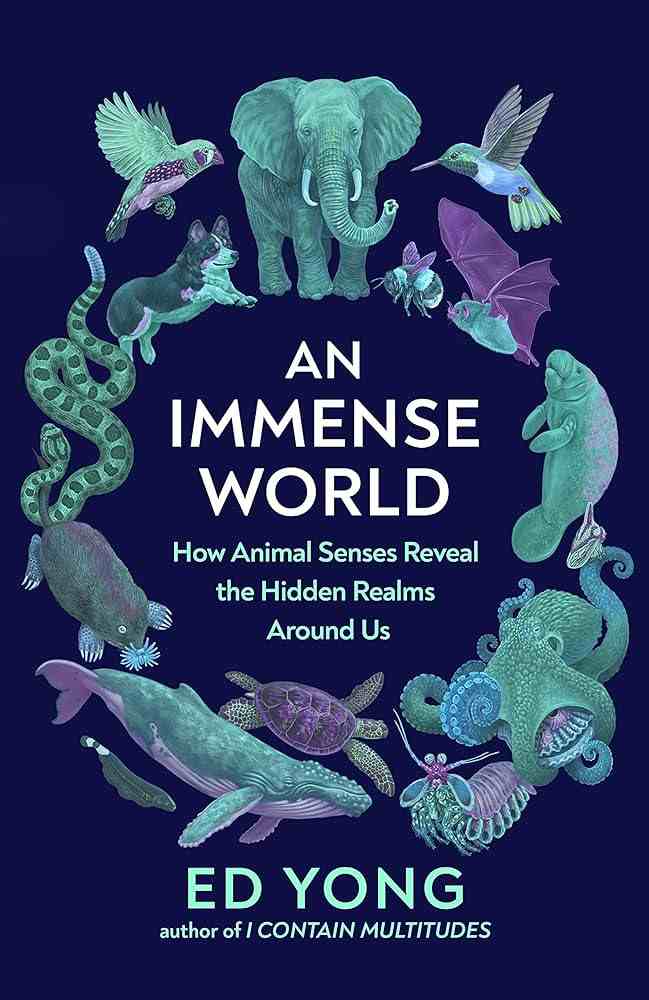
An impressive book, full of wonderful facts and some grounded speculations looking at how various creatures sense, and make sense, of the world around them. Ed Yong (the author) reminds us that trying to understand the behaviour of creatures based on what we can sense can be futile. And by forcing creatures into a human centric world (near constant lighting at night, urban noise, artificial chemicals in the environment), we may be altering their behaviour and damaging the natural biodiversity.
Ed Yong starts by introducing the reader to the term, Umwelt (as used by biologist Jakob von Uexkül) to represent each creature's unique perception of the world. He then shows us the Umwelts of various creatures as experienced through the various senses: smell, taste, light, colour, the sensation of pain and heat, contact, vibrations and sound. He then covers three of the more mysterious senses; echolocation and the ability to …
An impressive book, full of wonderful facts and some grounded speculations looking at how various creatures sense, and make sense, of the world around them. Ed Yong (the author) reminds us that trying to understand the behaviour of creatures based on what we can sense can be futile. And by forcing creatures into a human centric world (near constant lighting at night, urban noise, artificial chemicals in the environment), we may be altering their behaviour and damaging the natural biodiversity.
Ed Yong starts by introducing the reader to the term, Umwelt (as used by biologist Jakob von Uexkül) to represent each creature's unique perception of the world. He then shows us the Umwelts of various creatures as experienced through the various senses: smell, taste, light, colour, the sensation of pain and heat, contact, vibrations and sound. He then covers three of the more mysterious senses; echolocation and the ability to sense electric and magnetic fields. Each sense is shown by giving examples of various creatures whose ability to use the sense differs and/or exceeds our abilities to use them.
He then closes the book by showing how animals draw upon the various senses to form each creature's Umwelt, and how we are altering what creatures are sensing from their surroundings by 'polluting' the environment with our lights, noise and artificial chemicals.
Throughout the book, Ed Yong features the research and work being done by numerous researchers to understand how creatures sense the world and, possibly, how they make sense of the world using the information provided by the senses.
It may be impossible to fully imagine how even familiar creatures like dogs sense the world compared to us, much less creatures like spiders, birds, fishes, electric eels, moles or elephants (all examples from the book). But Ed Yong gives it a good try, and by the end, you'll probably appreciate the fact that we may never share the Umwelt of other creatures, but you'll be aware that they see the world differently from us and that needs to be accounted for when trying to understand why they behave in certain ways that may seem puzzling to us, limited as we are by our own Umwelts.
Bought this issue of Clarkesworld (from DRM-free bookstore Weighlessbooks) as a sample to help decide if I should subscribe to them. (This is after Neil Clarke won the 2022 Hugo Award for Best Short Form Editor.)
I could have read the stories free on-line, but SF magazines needs income to support them, and the cost of one issue was reasonable.
An average issue of Interzone, with interesting stories by Alison Wilgus, G.V. Anderson and Sean McMullen.
"The Backstitched Heart of Katharine Wright" by Alison Wilgus: an interesting story involving Katharine Wright, the sister of the famous Wright brothers (Orville and Wilbur) who suddenly discovers the ability to find a particular 'thread' of time, jump back through time and alter the future. This she does to help save her brother from an early death from a bicycle accident, and twice during their early flying days. But when Wilbur dies from typhoid fever, possibly an unavoidable death, she has to decide whether she wants to jump back through time one last time to try to save him and keep their family together.
"The Fukinaga Special Chip Job" by Tim Chawaga: a glimpse of a future where people live in mainly isolated cities and some people make a living by hunting through the …
An average issue of Interzone, with interesting stories by Alison Wilgus, G.V. Anderson and Sean McMullen.
"The Backstitched Heart of Katharine Wright" by Alison Wilgus: an interesting story involving Katharine Wright, the sister of the famous Wright brothers (Orville and Wilbur) who suddenly discovers the ability to find a particular 'thread' of time, jump back through time and alter the future. This she does to help save her brother from an early death from a bicycle accident, and twice during their early flying days. But when Wilbur dies from typhoid fever, possibly an unavoidable death, she has to decide whether she wants to jump back through time one last time to try to save him and keep their family together.
"The Fukinaga Special Chip Job" by Tim Chawaga: a glimpse of a future where people live in mainly isolated cities and some people make a living by hunting through the remains of civilization. In this case, hunting for a rare brand of potato chips.
"This Buddhafield is Not Your Buddhafield" by William Squirrell: a tale that goes nowhere, as far as I can tell. A maid is offered a job cleaning a floating mansion above Uranus, which she does, year after year. And as the years past, her connections to her family and humanity gradually disappear. Yet, she never questions her job or why she still works there.
"For the Wicked, Only Weeds Will Grow" by G.V. Anderson: an unusual tale about a colony of alien, mobile plant-like species who ease people waiting to die by providing pain-reducing drugs. One day, a grumpy terminal patient arrives, and it would involve a lot of patience and communication from one alien provider to ease his journey into death.
"Seven Stops Along the Graffiti Road" by David Cleden: a meandering story about people who seem to be wandering forever down a forest road, looking for it to end, and meeting fellow travellers along the way. Unresolved threads make the story feel like a fragment of a larger tale.
"Terminalia" by Sean McMullen: an interesting glimpse of an alternate history where rich and powerful people can live for longer (and keep control of their wealth) by having their 'souls' transferred into mechanical beings. One group wants to break their stranglehold, but it would involve a temporary death of an associate and the involvement of a doctor who can revive people who have cardiac arrests.
An above average issue, with mostly 'mild' fantasy stories (mild in the sense that there is minimal magic involved). Among those that stood out for me are the ones by Carrie Vaughn, Sean McMullen and Pip Coen.
"To the Beautiful Shining Twilight" by Carrie Vaughn: the fairy king revisits the home of a member of a group of human musicians, who once saved his kingdom, after many years. Time has moved on for her, and she is reluctant to get involved with him again. But he pleads with her to do one more small task, at the end of which he offers her a choice. Will she choose to be involved in his fairy kingdom again?
"The Province of Saints" by Robert Reed: a thoughtful story about a police office called in to help on a case where an entire family has been killed except for one member, the daughter. …
An above average issue, with mostly 'mild' fantasy stories (mild in the sense that there is minimal magic involved). Among those that stood out for me are the ones by Carrie Vaughn, Sean McMullen and Pip Coen.
"To the Beautiful Shining Twilight" by Carrie Vaughn: the fairy king revisits the home of a member of a group of human musicians, who once saved his kingdom, after many years. Time has moved on for her, and she is reluctant to get involved with him again. But he pleads with her to do one more small task, at the end of which he offers her a choice. Will she choose to be involved in his fairy kingdom again?
"The Province of Saints" by Robert Reed: a thoughtful story about a police office called in to help on a case where an entire family has been killed except for one member, the daughter. As the office interrogates the daughter, whom he has known since childhood, details of their relationship and the family's terrible stranglehold over the local county are revealed. But the ultimate revelation would be about a substance that would be the ultimate cause of the deaths and, predicts the office, possibly the end of civilization. Suffice to say, the substance enhances a particular emotion and causes internal agony when too much is used.
"Joe Diabo's Farewell" by Andy Duncan: a story about a Native American Indian who witnesses the death of a fellow construction worker in the city in the early 20th century. With work stopped for the day, he takes the chance to dress up as an Indian as part of a display before a film about General Custer. His actions on that day, would make him rethink his relationship with the dead worker. A story with a small touch of fantasy elements.
"The City of Lost Desire" by Phyllis Eisenstein: a story of a musician with some magical powers of movement that has joined a desert caravan on its way to an old city. The caravan carries a powder that is a powerful mind changing drug and much desired by the king of the city. But things take an interesting turn when the musician is apparently the only one able to open the entrance to an old tower near the city, which makes him a noble person in the eyes of the king; perhaps noble enough to marry his daughter. Political and business intrigue gathers pace in this mildly magical and fantasy story.
"The Right Number of Cats" by Jenn Reese: a short short about a person who fights off the addition of another cat to her household. The cat must work hard to convince her otherwise.
"Survey" by Adam-Troy Castro: a disturbing story set in dialogue-form between two people involving a survey whose continuing answers to questions would have a horrifying effect on both the person surveyed and the people whose lives would be affected by the choices during the survey.
"Blue as Blood" by Leah Cypess: a girl grows up on an alien world where the colour blue is culturally treated with disgust. Then she returns to Earth and continues to have violent emotional reactions to seeing anything blue. Even when the reactions gradually die down, she discovers her relationship with her parents and peers and constantly coloured by her reaction to blue and to grumblings about the way the aliens treat humanity.
"The Washer from the Ford" by Sean McMullen: a fascinating story involving a man who, after witnessing a stabbing, stumbles into the fairy world that exists among us and discovers not only a gift for seeing other people's emotional states but also a curse that afflicts him. As the story progresses, he learns not only of his capabilities, but also the various links between the human and fairy world that turn this story into an interesting fairy detective story to be solved.
"Tactical Infantry Bot 37 Dreams of Trochees" by Marie Vibbert: after being involved in endless battles and seeing soldiers die, the remaining battle bots, who have started to distract themselves from the battles by developing 'hobbies', also start having 'electric dreams' and assert their independence.
"Fifteen Minutes from Now" by Erin Cashier: a rambling, one-sided conversation by a person who claims to be a time traveller sent (multiple times) to torture information out of a potential terrorist who is about to detonate a bomb. Time travel paradoxes mixed with threats are, sadly, not my kind of story to like.
"The Fall from Griffin's Peak" by Pip Coen: a mild fantasy story about a thief hired to steal a special item from a store with magical protection. Told in a way that makes you sympathetic towards the thief (from the treatment she gets from the people who hire her), but it's given a rather surprising and emotional twist at the end that makes you re-evaluate your conclusions about the behaviour of the thief and the people who hired her.
A fascinating book about an elusive character, Peter Higgs, an elusive particle, the Higgs boson, and how the two would lead Higgs to getting an elusive prize, the Nobel. With access to Higgs and other scientists, the author is able to give a good idea of who Higgs is and his personality, as well as give the reader an idea of how the Higgs mechanism operates and its importance to particle physics.
The book starts with a biography of Higgs, who was inspired to take up physics upon learning that physicist Paul Dirac was an alumnus from his school. His initial desire to study quantum physics get accidentally derailed by his supervisor, leading him to take up molecular physics before eventually turning back to the field of quantum physics.
Then, theories about how superconductivity occurs would turn out to be the inspiration for Higgs to write his famous two papers …
A fascinating book about an elusive character, Peter Higgs, an elusive particle, the Higgs boson, and how the two would lead Higgs to getting an elusive prize, the Nobel. With access to Higgs and other scientists, the author is able to give a good idea of who Higgs is and his personality, as well as give the reader an idea of how the Higgs mechanism operates and its importance to particle physics.
The book starts with a biography of Higgs, who was inspired to take up physics upon learning that physicist Paul Dirac was an alumnus from his school. His initial desire to study quantum physics get accidentally derailed by his supervisor, leading him to take up molecular physics before eventually turning back to the field of quantum physics.
Then, theories about how superconductivity occurs would turn out to be the inspiration for Higgs to write his famous two papers that would propose a mechanism for how some particles get mass. Of course, he was not the first to get the idea, but his paper would contain an additional item that would propel him to 'stardom': a prediction about a particle that is associate with the mechanism.
By examining the chronology of events in that critical period, the author gives a look at the research happening at that time by Higgs and other scientists that would eventually lead to the particle being called the Higgs boson, despite the mechanism for giving mass to particles being proposed by other scientists before Higgs. As it turns out, mistakes in assigning priority in highly cited papers would give the impression that Higgs was the first to get the idea.
With advances in experimental particle physics (especially the machines used to accelerate and detect particles) and theoretical physics pointing the way, the hunt was on to find the Higgs particle that would complete what would now be known as the Standard Model of particle physics. The highlight would be the announcement at the Large Hadron Collider (LHC) of the discovery of the Higgs particle, with Higgs and other scientists who came up with the idea, present to hear the news.
But that would not be the end of it. Higgs, a private person, would now be in the spotlight for getting a Nobel Prize. But on the day of the announcement itself, Higgs decides to 'vanish' to avoid the media scrambling to interview him. But there is no avoiding the media on the day of the prize presentation itself.
This is one of the more accessible books about particle physics and the people who study them to try to figure out how nature works. The appendix of the book includes Higgs's two papers, where he shows the need for a Higgs mechanism to provide mass to some particles and the implications of the mechanism (the Higgs particle). Both papers are one page long each, but together, they would lead many people to come together to discover whether that is how the universe actually works.
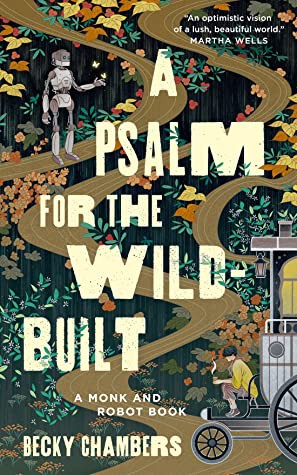
An interesting, character driven story that starts with a monk that is dissatisfied with the way their (singular they) life is and goes on a voyage of exploration as a tea monk, serving various kinds of teas they has selected to people who just need to unwind.
But even this proves not to be enough to quell the unease in the monk, and they go on a journey to visit an abandoned place in what would be the wild part of the moon the monk inhabits. On the journey, they would encounter the first sentient robot (the robots left for the wild woods after gaining sentience) to be seen by man for many years, who is also on a journey to find out what people need.
In their journey together, they would converse on the nature of man and robot, their desires and curiosity about each other and the world …
An interesting, character driven story that starts with a monk that is dissatisfied with the way their (singular they) life is and goes on a voyage of exploration as a tea monk, serving various kinds of teas they has selected to people who just need to unwind.
But even this proves not to be enough to quell the unease in the monk, and they go on a journey to visit an abandoned place in what would be the wild part of the moon the monk inhabits. On the journey, they would encounter the first sentient robot (the robots left for the wild woods after gaining sentience) to be seen by man for many years, who is also on a journey to find out what people need.
In their journey together, they would converse on the nature of man and robot, their desires and curiosity about each other and the world around them. By the end, the monk may, perhaps, have found what they want. But their journey to find out what other people want may be just beginning.
Not much is actually revealed about the world they inhabit (how it came about, etc.), but a quiet, gentle book about a person and a robot with differing points of view discussing the nature of how people might live and see the nature of their world.
An interesting change from the usual plot and science driven SF that I usually read.
The usual story of an immigrant who tries to make it in his new adopted home. Only here, the immigrant is of Indian descent from America, and his adopted home is India, where he has migrated to work at "India World", a Disneyland type theme park in India meant to showcase all that is good about a rising, and confident, India that employs 'returning' Indians.
But as in some stories of immigrants, prejudice against immigrants raises its head, and it ties back to the troubles migration had on his family when they moved from India to the US. In the end, he has to decide whether to remain an up and rising migrant in India, or return to America (which, to him, is his homeland) and help his father make it a better place.
An unexpected story of 'reverse' migrations, set in a future where India is now a rising …
The usual story of an immigrant who tries to make it in his new adopted home. Only here, the immigrant is of Indian descent from America, and his adopted home is India, where he has migrated to work at "India World", a Disneyland type theme park in India meant to showcase all that is good about a rising, and confident, India that employs 'returning' Indians.
But as in some stories of immigrants, prejudice against immigrants raises its head, and it ties back to the troubles migration had on his family when they moved from India to the US. In the end, he has to decide whether to remain an up and rising migrant in India, or return to America (which, to him, is his homeland) and help his father make it a better place.
An unexpected story of 'reverse' migrations, set in a future where India is now a rising power (with little mention of China), while America itself seems to be caught in the rut of decline, making the choices for the immigrant more stark.