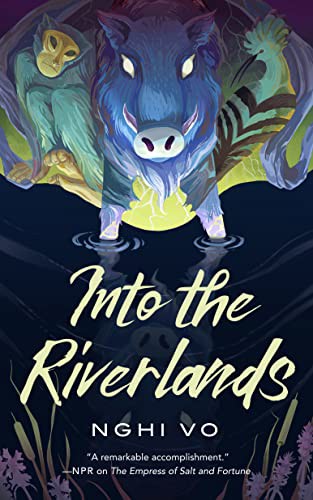
Soh Kam Yung wants to read Into the Riverlands by Nghi Vo
Adding this now, so I won't forget to read it when it's out. :-)
Announcement at [ www.tor.com/2022/01/11/cover-reveals-into-the-riverlands-by-nghi-vo/ ]
Exploring one universe at a time. Interested in #Nature, #Photography, #NaturePhotography, #Science, #ScienceFiction, #Physics, #Engineering.
I have locked this account. If you would like to follow me, please fill in your Mastodon bio and post at least one toot (a simple introductory toot will do), so I have an idea who you are and that you are a real person, not a robot or a spam account.
This link opens in a pop-up window
Adding this now, so I won't forget to read it when it's out. :-)
Announcement at [ www.tor.com/2022/01/11/cover-reveals-into-the-riverlands-by-nghi-vo/ ]
A fascinating and, at times, personal, journey through time, space, and history by the author as she explores not just the universe as we know it, but also the various stories of people throughout history who have placed the importance of science and other people above their own. The book is not only about 'Possible Worlds' but also, like the first Cosmos series by Carl Sagan, a 'Personal Journey' by the author who not only wants the readers to see the wonders the universe has to offer, but also some of the trials she has to go through to keep the ideas and ideals of Carl Sagan alive.
"Ladder to the stars" gives an overview of the journey with the Cosmic Calendar (that compresses all of the time from the Big Bang to the present into one calendar year). Highlights from the calendar are presented, from the creation of Earth, …
A fascinating and, at times, personal, journey through time, space, and history by the author as she explores not just the universe as we know it, but also the various stories of people throughout history who have placed the importance of science and other people above their own. The book is not only about 'Possible Worlds' but also, like the first Cosmos series by Carl Sagan, a 'Personal Journey' by the author who not only wants the readers to see the wonders the universe has to offer, but also some of the trials she has to go through to keep the ideas and ideals of Carl Sagan alive.
"Ladder to the stars" gives an overview of the journey with the Cosmic Calendar (that compresses all of the time from the Big Bang to the present into one calendar year). Highlights from the calendar are presented, from the creation of Earth, the rise of life on Earth, the rise of humanity until human civilization is established.
"Oh, Mighty King" shows humanity's struggle to understand the universe and the supernatural nature of good and evil in an unfeeling universe. The chapter begins with Zoroastrianism and ends with the story of the Indian Emperor Ashoka, who started out being an embodiment of evil, yet was changed by Buddhism to become a paragon of good in India.
"Lost city of life" looks at how life might have developed on Earth, deep under the sea, in vast towers of minerals that sheltered and nurtured the first life forms. It then gives a brief look at the lives of some of the scientists who looked at chemistry and biochemistry, and ends with a consideration of other worlds and moons in the Solar System that may well harbour life as we know it.
"Vavilov" tells the story of agriculture and the struggle to prevent hunger by growing better types of grains and other plants. It also tells the story of Nikolai Vavilov, a Russian scientist whose botanical skills would lead to the identification of the centre of origins for various agricultural plants. But his is not a happy story, for it takes place prior and during the Second World War and would involve Stalin and Trofim Lysenko.
"The cosmic connectome" looks at the brain and the mystery of its numerous connections that give us the ability to think and of awareness. Starting from how animals evolved the brain, the chapter also covers the history of brain research from recognizing that the brain is the seat of thinking to the discovery of what different parts of the brain do, to detecting signals from the brain to current brain research that is revealing the large number of connections between neurons in the brain.
"The man of a trillion worlds" looks at the lives of two scientists during the period in the 20th century when the search for the beginnings of life on Earth and the possibility of life on other planets was being researched: Gerald Kuiper and Harold Urey. The chapter also looks at the graduate student who would be a bridge between them: Carl Sagan, who would also organize the first group to study how life might exist on other planets.
"The search for intelligent life on earth" considers the search for intelligent life in the universe by looking at what may be intelligent life on earth (besides us). From the web of fungi and plants to the 'dance' of bees, the examples chosen show what intelligent life might look like if we were to consider the ways it expresses itself in the way communities of plants and animals live.
"The sacrifice of Cassini" gives an overview of what made the Cassini mission to Saturn possible. Starting with a history of the astronomical observations of Saturn, the chapter moves on to the story of the Russian who dreamed up the idea of gravitational assist, an idea that would make most interplanetary missions possible. The chapter ends with some discoveries made by the Cassini probe before it was commanded to end its mission by crashing into Saturn, to protect the moons of Saturn from possible contamination from Cassini.
"Magic without lies" looks at the strange nature of light. From the early arguments between Newton and Huygens over whether light is a wave or made up of particles, to the mysterious interference experiments of Thomas Young and the mysterious inner quantum nature of light shown by Bell's Theorem, the chapter offers a glimpse that we still don't really understand light, much like Flatlanders don't really grasp the nature of the third dimension.
"A tale of two atoms" tells the tale of two kinds of atoms. One is carbon, which is the basis for life as we know it, the other is uranium, from which some of the most destructive weapons would be created. The two kinds of atoms would meet when humanity would harness uranium for its destructive power.
"The fleeting grace of the habitable zone" looks at what will happen as the sun ages. At first, it will give off more light (and heat), forcing humanity (if it still exists far in the future) to abandon Earth to live on worlds further from the sun. But as the sun becomes a white dwarf and cools, humanity will have no choice but to move to another star system. Is this possible? The author imagines the journey our ancestors did to navigate the great unknown oceans of Earth and believes such an incredible journey to other stars may one day be possible.
"Coming of age in the Anthropocene" this chapters looks at what humanity has done to change the earth enough that we are now living in a human-caused age. The rise of hunting, agriculture and, ultimately, technology, has enabled humanity to change and modify the Earth. More than that, humanity has the ability to predict what will happen in the future (via examples like the ozone hole caused by Chlorofluorocarbon, or climate change caused by increasing amounts of Carbon dioxide). But the question is whether humanity is willing to act on it.
"A possible world" end the book the way it started: with a look at the World's Fair. While the introduction showed the 1939 World's Fair seen by Carl Sagan, the one featured here shows a World's Fair in the near future on a world recovering from the damage done by humanity. It is possible? Perhaps.
An interesting biography of Stephen Hawking, with the illustrations helping to bring to life the way he lived and his interactions with the people around him.
Starting with his birth, it covers his early life, his education and scientific career, as well as his marriages and relationship with his children. The book also covers historical aspects of science (cosmology, quantum theory and general relativity) to give some context on his work in the theory concerning black holes. Other aspects of his life as also covered, like the gradual discovery that he had motor neuron disease and his struggles to live a working life.
The book is roughly divided into two parts. The first part is before he became famous and well known for his work on black holes and on the popular book, "A Brief History of Time" and the second half is after he became famous and travels the …
An interesting biography of Stephen Hawking, with the illustrations helping to bring to life the way he lived and his interactions with the people around him.
Starting with his birth, it covers his early life, his education and scientific career, as well as his marriages and relationship with his children. The book also covers historical aspects of science (cosmology, quantum theory and general relativity) to give some context on his work in the theory concerning black holes. Other aspects of his life as also covered, like the gradual discovery that he had motor neuron disease and his struggles to live a working life.
The book is roughly divided into two parts. The first part is before he became famous and well known for his work on black holes and on the popular book, "A Brief History of Time" and the second half is after he became famous and travels the world giving lectures and having the time of his life.
Much of the book looks at his scientific contributions and may well leave some readers puzzled over the work that his did. But other aspects of his life (his relationship with his wives, children and people he worked with) are also shown that reveal how he works and communicates with them.
Overall, an interesting and scientifically general book about one of the more interesting scientists of our time.
A better than average issue with good tales by Matthew Hughes, Gregor Hartmann, Amanda Hollander, Elizabeth Bear and a fantastic tale involving thinking mechanicals beings by Ian Tregillis.
"Kikelomo Ultrasheen" by Dare Segun Falowo: an African fantasy story about a girl blessed or cursed with the ability to affect people by weaving and perming their hair. When she is forced to run away to the city, she falls into the company of people who can use her ability until she returns years later to her mother to fulfil her destiny.
"The Million-Mile Sniper" by SL Huang: a somewhat unbelievable tale of a sniper that can find its target spaceship ffom an unimaginable distance away, and a detective who somehow is able to deduce what happened from the evidence.
"The Last Legend" by Matthew Hughes: a fascinating tale about a boy who is destined for greatness; until tragedy strikes, and he …
A better than average issue with good tales by Matthew Hughes, Gregor Hartmann, Amanda Hollander, Elizabeth Bear and a fantastic tale involving thinking mechanicals beings by Ian Tregillis.
"Kikelomo Ultrasheen" by Dare Segun Falowo: an African fantasy story about a girl blessed or cursed with the ability to affect people by weaving and perming their hair. When she is forced to run away to the city, she falls into the company of people who can use her ability until she returns years later to her mother to fulfil her destiny.
"The Million-Mile Sniper" by SL Huang: a somewhat unbelievable tale of a sniper that can find its target spaceship ffom an unimaginable distance away, and a detective who somehow is able to deduce what happened from the evidence.
"The Last Legend" by Matthew Hughes: a fascinating tale about a boy who is destined for greatness; until tragedy strikes, and he is forced to make a living with a lowly job. An incident later happens, and he is forced to run away. Then, while in the company of another man, he encounters a strange magical dead region with only a blind man living in it. As in all such tales, it would be destiny that they would all come together at that time; or perhaps the strong hand of determinism and the strange lack of free will.
"Come the Revolution" by Ian Tregillis: a gripping tale set in an alternative world where mechanical thinking beings serve humans and are limited in their actions by the interaction of various internal geas that force them to obey commands or suffer 'pain'. But one particular mechanical 'dreams' of being free, and one day that dream is fulfilled; with repercussions for humanity.
"Red Sword of the Celiac" by John Possidente: a short piece about a reviewer reluctantly reviewing an editor's favourite 'unknown author' book.
"Say You're Sorry" by Amman Sabet: a tale where saying you are sorry but not meaning it will have physical repercussions for the person involved.
"A Solitary Crane Circles Cold Mountain" by Gregor Hartmann: an interesting look at a future where civilization has become more environmentally oriented. But one last legacy of the previous 'machine-oriented' past remains: a hollow asteroid to be launched to a new world on a journey that will last many generations. It is the job of one woman to figure out how the inhabitants of the asteroid will survive the journey with an 'intact' society (not reverting to, say, cannibalism) but as her many attempts to create a working one fail, it may require a rethink and a journey to simpler times for her to get the right answer.
"A Feast of Butterflies" by Amanda Hollander: an unusual fantasy story about a police officer in an unnamed area ruled by a corrupt landowner who demands that he arrests a girl that may be linked to the disappearance of his grandson. During his investigations, he learns more about the unusual girl who feasts on butterflies from his predecessor's files and comes to an arrangement with her to locate the grandson and get rid of the landowner in a most unusual manner.
"Hungry Is the Earth" by William Ledbetter: on an Earth invaded by strange plants that are harvested by aliens, one girl struggles to feed and save his younger brother. But hope seems lost when her plant seeds fail, and she makes one last desperate attempt, not knowing if it will kill them or turn them into something not quite human.
"Hacksilver" by Elizabeth Bear: a returning Viking discovers his brother's farm taken over and his brother exiled for a crime. When he himself is exiled, he has only his wits to help him in a wresting match with a giant and prove that his brother has been framed for the crime.
"Death on the Nefertem Express" by Brian Trent: when a train that stays on the edge of disaster on a planet breaks down, it takes a probable pirate turned detective to figure out who caused the breakdown, why and how to save herself and the passengers. The clue to solve the mystery is there for the reader to see.
"The Man I Love" by James Patrick Kelly: in an unusual bar where ghosts come to congregate, one lonely ghosts waits for a special person to come to to bar. And on this night, he does indeed come.
An average issue, with interesting stories by Gregor Hartmann, Andy Dudak and John Possidente.
"Each Cell a Throne" by Gregor Hartmann: a private detective is given the job of convincing an old man not to upload himself into a computer. As they argue back-and-forth, the story reveals the detective also has her own reasons for trying to convince him not to do it.
"Flyover Country" by Julie C. Day: in a future full of man-made diseases, one person has a job taking care of a field until, one day, it is used for an unsaid biological mission by a company. Striking up a romantic relationship was an unplanned part that would lead to heartbreak and possible biological contamination.
"Frankie" by Daniel Bennett: in the middle of a war, only the writings of one person, Frankie, appears to hold a country together. But when he dies, who is left to hold …
An average issue, with interesting stories by Gregor Hartmann, Andy Dudak and John Possidente.
"Each Cell a Throne" by Gregor Hartmann: a private detective is given the job of convincing an old man not to upload himself into a computer. As they argue back-and-forth, the story reveals the detective also has her own reasons for trying to convince him not to do it.
"Flyover Country" by Julie C. Day: in a future full of man-made diseases, one person has a job taking care of a field until, one day, it is used for an unsaid biological mission by a company. Striking up a romantic relationship was an unplanned part that would lead to heartbreak and possible biological contamination.
"Frankie" by Daniel Bennett: in the middle of a war, only the writings of one person, Frankie, appears to hold a country together. But when he dies, who is left to hold the country together?
"Salvage" by Andy Dudak: in a future where most of humanity has been suddenly frozen into statues by aliens concerned with the increasing expansion of the universe (there's a reason for this), one person interfaces with the statues; for their mental states are still running, but in a very slow state. She informs them of their state and gives them the option of being extinguished, left as they are, or uploaded into a virtual place. As she gets to know them, she learns of their history and their anger and demands for justice against a tyrant who ruled over them when they were frozen.
"The Dead Man's Coffee" by John Possidente: a journalist looking for a story talks to a man about a trail on another world, while drinking coffee on a space station. Without gravity, some coffees are more expensive than others, and only by accident does she get to drink the expensive coffee of a dead man.
A fun book that uses the premise of a time traveller stranded in the past and having to make the best of things by starting off humanity on the path of civilization. The means of doing this is by bypassing the trial and errors that humanity went through and going straight to the solutions needed to set up a working modern civilization.
The book starts off with tips for the stranded time traveller to find out where and when he might be. Assuming the traveller is lucky and ends up in a certain time period where modern man was around, but civilization hasn't been established yet, the book goes on with the basis of setting up a civilization, namely getting a spoken and written language, a 'rational' system of numbers and establishing the scientific method.
Farming is then introduced so that people's basis calorie needs are satisfied and can devote …
A fun book that uses the premise of a time traveller stranded in the past and having to make the best of things by starting off humanity on the path of civilization. The means of doing this is by bypassing the trial and errors that humanity went through and going straight to the solutions needed to set up a working modern civilization.
The book starts off with tips for the stranded time traveller to find out where and when he might be. Assuming the traveller is lucky and ends up in a certain time period where modern man was around, but civilization hasn't been established yet, the book goes on with the basis of setting up a civilization, namely getting a spoken and written language, a 'rational' system of numbers and establishing the scientific method.
Farming is then introduced so that people's basis calorie needs are satisfied and can devote energy to other matters. Units of measurements (length, weights, etc.) are added, followed by more details on how to farm more productively (selective breeding and crop rotation). A list of plants and animals that are useful are also given.
Once people can be properly fed, industry is then added. Basic farming technology is added (the plough and harness), followed by ways to preserve food. Mining machinery is added, leading to more machines and the beginnings of the industrial age, all the way to electrical machines.
Other basic items of civilization are introduced like clocks, thermometers, sewing, birth control, housing materials (cement and concrete), paper and transport (bicycles, boats, aeroplanes) are added. The basics of medicine and first aid are added, and the book ends of 'luxuries' like music and the basics of computers.
With that, the stranded time traveller might be able to 'kick-start' humanity on the path of civilization and end up where he or she started, with the abilities to build a time machine to go back in time, again.
An okay issue, with interesting stories by Essa Hansen, Matthew Hughes, Alex Irvine, Albert E. Cowdrey and Auston Habershaw.
"Save, Salve, Shelter" by Essa Hansen: in this future, environmental disaster has happened and what remains of humanity is leaving for Mars. Collectors are tasked with collecting DNA samples from animals that still survive to take with them. But one collector wants to do more and bring the animals to Mars. As ship after ship rejects her, she makes one last desperate move for her animals, not seemingly aware of the changes happening to her charges.
"Air of the Overworld" by Matthew Hughes: a wizard subjects a henchman to strange experiments that may have to do with sending him to another plane of existence (the Overworld) to collect materials for him. Becoming aware of the dangers this endeavour might do to him, he plans to escape with the help of an …
An okay issue, with interesting stories by Essa Hansen, Matthew Hughes, Alex Irvine, Albert E. Cowdrey and Auston Habershaw.
"Save, Salve, Shelter" by Essa Hansen: in this future, environmental disaster has happened and what remains of humanity is leaving for Mars. Collectors are tasked with collecting DNA samples from animals that still survive to take with them. But one collector wants to do more and bring the animals to Mars. As ship after ship rejects her, she makes one last desperate move for her animals, not seemingly aware of the changes happening to her charges.
"Air of the Overworld" by Matthew Hughes: a wizard subjects a henchman to strange experiments that may have to do with sending him to another plane of existence (the Overworld) to collect materials for him. Becoming aware of the dangers this endeavour might do to him, he plans to escape with the help of an inhabitant of the Overworld that he once helped.
"Banshee" by Michael Cassutt: when an experimental spaceship keeps suffering problems, it is up to a well-connected problem solver to figure out a solution. But he finds himself 'out of the loop' when his initial proposed solution is not accepted. But he eventually figures out an alternative solution with the help of his daughter who, in this story, has undergone a radical change and become a dinosaur (radical body morphs being another part of the story).
"Chisel and Chime" by Alex Irvine: a light fantasy story with a heavy theme around art and death. A sculptor is given the task of producing a statue of a local despot, a task that would end with her death. Watching over her is a soldier, whose origin story of living in a village and then running away and ending up as her guard would show that he does not know how his task will also end. And yet, with the help of a special bell from the guard that has the ability to contain the ghost of a departed person, she comes up with a desperate plan to save him from the designs of the despot after her death.
"Elsinore Revolution" by Elaine Vilar Madruga: a short short story of a future where multiple Shakespeares write plays, only one particular Shakespeare character does not want to do its appointed role.
"Falling Angel" by Albert E. Cowdrey: two psychics are called to rid a new development in Hollywood of the agonizing scream of a woman who fell to her death years ago. But as they research her background and the circumstances of her death, they discover the person who caused her death may not be an actual person at all.
"The Key to Composing Human Skin" by Julianna Baggott: an unusual story set in a country (maybe the USA) under the rule of tyranny. In a firm tasked with the job of delivering messages from the government more effectively, one person comes up with the idea of messages the user can't escape from, like a rash on their skin. Without spoiling the story, the idea is implemented in an unusual way that expresses the users' actual thoughts that they can't escape from.
"Interlude in Arcadia" by Corey Flintoff: a professor of Greek Literature finds himself stumbling into a world where Greek myths come to life, and they may not treat him too kindly.
"Three Gowns for Clara" by Auston Habershaw: when a Prince makes a proclamation and invites (demands) all maidens to attend a ball, it falls on to an old seamstress to quickly make three gowns for a duke. This, she does, sacrificing her time and that of her helper and her grandniece, who now does not have the time to make her own dress for the ball. But perhaps with a change of heart, the grandniece may have her chance to shine at the ball.
"The Nameless" by Melissa Marr: a story of a forest where women live and fight off 'wolves' that threaten them. Unfortunately, the premise of the story doesn't hold together very well, especially as more of the world beyond the forest the women live in is revealed in the story.
"The Leader Principle" by Rahul Kanakia: a story of a man (maybe modelled on SpaceX's Elon Musk) who dreams of getting rockets to Mars at any cost, and of his assistant who would do anything to ensure that dream becomes true, even if it means taking money from investors who have no hope of getting their money back and maybe even thinking of ways of enslaving the rest of the world.
An interesting book that looks at the author's fascination with the colour blue. He travels the world, talking to scientists and others, and gives a look at various aspects of blue: from objects with the colour to how we look at and react to blue.
"Stones" looks at how blue appears in stones and combinations of minerals. Lapis lazuli is known to be blue since ancient times and used for decorations. The Egyptians eventually figured out how to make Egyptian blue tiles. By grinding, heating and combining lapis lazuli with other substances, ultramarine blue was produced, a colour more valuable than its weight in gold. The act of alchemy would produce the next blue substance, Prussian blue. In modern days, a vivid blue would be accidentally created: YInMn Blue. And maybe one day, the mineral ringwoodlite that makes up much of the mantle is the earth could give another way …
An interesting book that looks at the author's fascination with the colour blue. He travels the world, talking to scientists and others, and gives a look at various aspects of blue: from objects with the colour to how we look at and react to blue.
"Stones" looks at how blue appears in stones and combinations of minerals. Lapis lazuli is known to be blue since ancient times and used for decorations. The Egyptians eventually figured out how to make Egyptian blue tiles. By grinding, heating and combining lapis lazuli with other substances, ultramarine blue was produced, a colour more valuable than its weight in gold. The act of alchemy would produce the next blue substance, Prussian blue. In modern days, a vivid blue would be accidentally created: YInMn Blue. And maybe one day, the mineral ringwoodlite that makes up much of the mantle is the earth could give another way to make blue.
"Seeing" looks at how we see colour, especially blue. Starting with the electromagnetic spectrum of visible light, he goes into the fine cells in eyes that let us see colour and why we see colour better than other mammals, but worse than birds and insects. He then shows how other cells in the eye are affected by blue light (even blind people), which is why blue light may set our daily rhythms, hence the movement to reduce blue light at night. A look at colour illusions (like the infamous blue dress image) are given. A brief look at the philosophical question of why we 'see' blue is also given.
"Plants" looks at how plants produce blue. From the mystery of why plants are green, the author then shows the challenges of producing blue flowers in plants. People in the past (and chemistry researchers today) have looked at pigments produced by plants to colour clothes and food. While red and yellow pigments are common, pigments for blue are rare and highly sought after. Producing a blue rose is also a target that is yet to succeed (although blue chrysanthemums have been produced). In the past, indigo was a popular blue dye, but now artificial dyes are common.
"Speaking" looks at how language affects how we refer to blue. Gladstone once had a theory that ancient Greeks couldn't perceive blue to explain why the word for blue is not used. But further studies would show that it is an effect of how language develops words for colours instead. Other studies would show that in a small way, having words to refer to different shades of blue can have an effect on whether people can more easily see shapes and shades of blue in experiments.
"Animals" looks at how animals use blue. Besides pigment, animals produce blue through the careful creation of structures that mainly reflect blue light. Harder to explain was why animals use blue, or colours in general. It was initially thought that colour was used just for camouflage. Later on, the idea that colours are used as a warning signal emerged. Then came the idea that colour is also used as a signal for fitness in mate selection. Unfortunately, humans preferences and desires for blue animals have driven some species to the edge of extinction.
"Speaking" looks at how language affects how we refer to blue. Gladstone once had a theory that ancient Greeks couldn't perceive blue to explain why the word for blue is not used. But further studies would show that it is an effect of how language develops words for colours instead. Other studies works show that in a small way, having words to refer to different shades of blue can have an effect on whether people can more easily see shakes and shades of blue in experiments.
Plants looks at how plants produce blue. From the mystery of why plants are green, the author then shows the challenges of producing blue flowers in plants. People in the past (and chemistry researchers today) have looked at pigments produced by plants to colour clothes and food. While red and yellow pigments are common, pigments for blue are rare and highly sought after. Producing a blue rose is also a target that is yet to succeed (although blue chrysanthemums have been produced). In the past, indigo was a popular blue dye, but now artificial dyes are common.
Seeing looks at how we see colour, especially blue. Starting with the electromagnetic spectrum of visible light, he goes into the fine cells in eyes that let us see colour and why we see colour better than other mammals, but worse than birds and insects. He then shows how other cells in the eye are affected by blue light (even blind people), which is why blue light may set our daily rhythms, hence the movement to reduce blue light at night. A look at colour illusions (like the infamous blue dress image) are given. A brief look at the philosophical question of why we 'see' blue is also given.
An interesting book consisting of fascinating stories about calculus. This is definitely not a calculus textbook but if you ever want to know what calculus was, what it is used for and some interesting facts and stories involving calculus, then this would be a book to read.
There are too many chapters to give a chapter by chapter summary. But the book is divided into two sections based on the two main mathematical parts that make up calculus.
The first section covers "Differentiation" and the derivative, or the idea that a derivate is an 'instantaneous change' in an object, be it time, position, and so on. It builds on that by using the example of Newton considering the moon constantly falling towards the earth sideways. Based on how much it 'falls' as it moves to remain in orbit around the earth, its speed can be calculated. The derivative is also …
An interesting book consisting of fascinating stories about calculus. This is definitely not a calculus textbook but if you ever want to know what calculus was, what it is used for and some interesting facts and stories involving calculus, then this would be a book to read.
There are too many chapters to give a chapter by chapter summary. But the book is divided into two sections based on the two main mathematical parts that make up calculus.
The first section covers "Differentiation" and the derivative, or the idea that a derivate is an 'instantaneous change' in an object, be it time, position, and so on. It builds on that by using the example of Newton considering the moon constantly falling towards the earth sideways. Based on how much it 'falls' as it moves to remain in orbit around the earth, its speed can be calculated. The derivative is also the rate of change of a quantity. For example, given your position over time, the 'First derivative' of it would be speed (change in position over time), the Second derivative would be acceleration (change in speed over time). Both Newton and Gottfried Leibnitz provided a notation for derivatives, but Leibnitz's notation proved to be more flexible than Newton's, showing that a proper notation can increase the flexibility for what derivatives can be used for.
Examples of the powers of derivatives are also given, staring with a danger in extrapolating trends via derivatives from too little data. A fascinating example is then given, via a story of using it to determine the direction a bicycle is moving.
A mystery or puzzle at the heart of derivatives is the question of how to 'approach the limits' in derivatives. Initially based on ideas from geometry, the book then shows lines and movements that cannot be differentiated (like Brownian motion), showing that there are limits to finding derivatives by geometric methods
Next, the derivative is used to show how it can find the maximum or the minimum point of a curve and how it can fail when a curve has no maximum. The story of the infamous Laffer Curve is also provided, showing its influence on supply side economics and tax policies. An interesting story is then told of a dog that can apparently apply calculus to the problem of find the best position to jump into the water to fetch a ball. Finally, the books shows that derivatives are used as a standard calculating tool.
The next section covers the "Integral" and how it can be used to calculate the area of a circle by 'slicing' it up into tiny sections and summing them up. Tolstoy's "War and Peace" is then used as a metaphor for integration: the sum of each tiny human experience making up the whole tapestry of history.
The integral is then introduction for calculating the area under a function. It is then shown that integration and derivation are 'fundamental theorems of calculus' and opposites of each other. But despite being opposites, differentiation has well defined methods but integration does not: integration depends on a bag of tools of various ways to perform integration. Some integration problems will only yield to certain tools.
One thing that integrals feature is the "Constant of Integration", an arbitrary number that usually appears and is unknown without knowing an initial condition. The book then looks at Einstein's regret in introducing such a constant into his equation for General Relativity to recreate a static universe, only to discover it was unnecessary in it original form but is now needed to explain the accelerating expansion of the universe.
Archimedes and his geometrical approach to integration is then shown via calculations of the volume of a pyramid and a cone. It is contrasted with using the algebraic formulation of calculus as a way to 'mechanize' calculus.
The paradox of 'Gabriel's horn' is then shown, a geometric shape with finite volume but infinite surface area. Finally, unlike differentiation, some Integrals have not formal solution and is still a constant struggle for current day mathematicians.
A good and informative book about the evolution of mammals, from their beginnings to the present day. The author shows that mammals never evolved from reptiles, but instead evolved alongside them. While mammals were small and easily overlooked during the age of the dinosaurs, that did not mean they were restricted: in fact, she shows that mammals kept evolving and filling ecological niches at that time, before they began to take on bigger challenges after the extinction of the non-avian dinosaurs.
Her descriptions of the fieldwork done in the past and today to form the modern picture of the evolution of mammals is fascinating. She also points out the colonialism, racism and sexism that was rife in palaeontology, that she and others are now changing, getting more women and local people involved in palaeontological research.
In short, a book that should be read to get the modern picture of the …
A good and informative book about the evolution of mammals, from their beginnings to the present day. The author shows that mammals never evolved from reptiles, but instead evolved alongside them. While mammals were small and easily overlooked during the age of the dinosaurs, that did not mean they were restricted: in fact, she shows that mammals kept evolving and filling ecological niches at that time, before they began to take on bigger challenges after the extinction of the non-avian dinosaurs.
Her descriptions of the fieldwork done in the past and today to form the modern picture of the evolution of mammals is fascinating. She also points out the colonialism, racism and sexism that was rife in palaeontology, that she and others are now changing, getting more women and local people involved in palaeontological research.
In short, a book that should be read to get the modern picture of the origins and evolution of mammals.
What follows is a chapter by chapter summary of the book:
Chapter one introduces the author, her field work on fossils on the Scottish Isle of Skye, and on the beginnings of the group that would give rise to mammals.
Chapter two gives a summary of the history of mammal fossils. When first found in rocks dating back to the age is the dinosaurs, mammal fossils were considered primitive and identified as belonging to marsupials. This is a misconception due to the idea of animals changing to become more sophisticated (and human) over time. It is only in modern times that modern marsupials are shown to be just as sophisticated as placental mammals and evolved alongside, not from, the reptiles and dinosaurs.
Chapter three looks back in time to the Carboniferous period, where most groups of life were starting to emerge on land. After the plants, the insects were the most abundant landform. But following behind were the animal groups that would give rise to the mammals and reptiles. While early mammals forms are often described as 'reptile-like', this is wrong. As the author shows, mammals and reptiles developed from different groups of animals (as shown through examination of their fossil skull bones in this period) and only resemble each other at that stage of life, leading to the misunderstanding.
Chapter four looks at the Permian period. It is during this time that the Synapsids began to get big, with animals like the well known Dimetrodon and others. Various explanations are provided for that animal's sail on its back. But it was also during this period that herbivores (plant eating animals) first developed.
Chapter five looks at other groups of animals that were also present during the Permian that descended from the Synapsids. One group, the Therapsids, would give the world predators and herbivores that are distinguished from other groups of animals by possessing specialized teeth for cutting and chewing. Another group, the Cynodonts, who would become the ancestors of the mammals, also developed a more upright gait, that would let them move more efficiently. It was around this time that evidence for hot-blooded animals can be found in the fossils.
Chapter six looks at the Triassic period, which came after a major extinction event that marked the end of the Permian. It took millions of years for the major groups of animals to recover, but when it did, the world would look very different. Gone were the Therapsids that dominated the Permian. In their place were the reptile groups that would give rise to various forms of crocodiles and that most well known of ancient animals, the dinosaurs. Why this happened is still subject to research.
Chapter seven continues to look at the development of animals during the Triassic that would eventually lead to animals that can be recognized as mammals. During this period, these animals would become smaller and become nocturnal, a successful way of living. Their hearing and sense of touch and smell would also become well-developed. Their teeth would also develop into specialized forms for eating.
Chapter eight looks at some is the technology, like CT scans and Synchrotron machines, that are able to penetrate stones and fossils to reveal their inner structure. This technology would be critical for analysing mammal fossils, as there are often small and fragile. The scanning technology world help to illuminate how some of the basic features of mammals, like whiskers, hair and the ability to provide milk, would begin to appear in ancient mammals.
Chapter nine looks at the mammal-like forms developing in the Jurassic period. Many were small, which initially caused many people to overlook them, concentrating on the much larger dinosaurs in that period. But closer examination shows that the mammal-like forms were developing new ways of living, like burrowing or gliding. Their small size may also have helped them to develop more sensitive hearing by helping to free up jaw bones to be used as inner ear bones.
Chapter ten looks at the ancestors of mammals and mammal-like animals in the Cretaceous. With dinosaurs now dominating the landscape, it can be easy to overlook the much smaller mammals during this time, but fossils continue to show mammals diversifying and finding new ways of living in a landscape that was also undergoing change, with the development of flowering plants.
Chapter eleven looks at what happens after the asteroid impact that lead to the extinction of the non-avian dinosaurs. Various forms of mammals (and other life forms) that survived flourished, leading to the world we now know. But the usual story that the dinosaurs were preventing mammals from developing, before the impact, may not be correct, if the author's research is correct, indicating that other kinds of mammals may also have had a hand.
Stones: A look at how blue appears in stones and combinations of minerals. Lapis lazuli is known to be blue since ancient times and used for decorations. The Egyptians eventually figured out how to make Egyptian blue tiles. By grinding, heating and combining lapis lazuli with other substances, ultramarine blue was produced, a colour more valuable than its weight in gold. The act of alchemy would produce the next blue substance, Prussian blue. In modern days, a vivid blue would be accidentally created: YInMn Blue. And maybe one day, the mineral ringwoodlite that makes up much of the mantle is the earth could give another way to make blue.