Soh Kam Yung commented on So Much Cooking by Naomi Kritzer

Can be read on-line [ clarkesworldmagazine.com/kritzer_11_15/ ]

Exploring one universe at a time. Interested in #Nature, #Photography, #NaturePhotography, #Science, #ScienceFiction, #Physics, #Engineering.
I have locked this account. If you would like to follow me, please fill in your Mastodon bio and post at least one toot (a simple introductory toot will do), so I have an idea who you are and that you are a real person, not a robot or a spam account.
This link opens in a pop-up window
Can be read on-line [ clarkesworldmagazine.com/kritzer_11_15/ ]
A food blogger notes down food recipes as a bird flu pandemic hits, isolating her and some children in their home. As ingredients get scarce, the recipes become more basic, but there is hope towards the end.

A good collection of stories about the Second Age of Middle-Earth, told in chronological order. The stories are from the writings by J.R.R Tolkien, as collected and edited in various books by Christopher Tolkien. Many of the stories concerns Númenor, from its rise as an island haven for Men in the west after the fall of Melkor (Morgoth), to its downfall (and the end of the Second Age) after being corrupted by Sauron.
The book starts with a look at the geography and ecology of Númenor, followed by what makes Númenoreans different from other men in Middle-Earth. The chronological story of the Second Age is then told, showing the rise of Númenor, first as teachers of the men of Middle-Earth, then becoming arrogant and turning into conquerors. The parallel story of Sauron, who deceives some of the Elves into crafting Rings of Power, only to craft the One Ring …
A good collection of stories about the Second Age of Middle-Earth, told in chronological order. The stories are from the writings by J.R.R Tolkien, as collected and edited in various books by Christopher Tolkien. Many of the stories concerns Númenor, from its rise as an island haven for Men in the west after the fall of Melkor (Morgoth), to its downfall (and the end of the Second Age) after being corrupted by Sauron.
The book starts with a look at the geography and ecology of Númenor, followed by what makes Númenoreans different from other men in Middle-Earth. The chronological story of the Second Age is then told, showing the rise of Númenor, first as teachers of the men of Middle-Earth, then becoming arrogant and turning into conquerors. The parallel story of Sauron, who deceives some of the Elves into crafting Rings of Power, only to craft the One Ring to rule them all, is also told, setting up the conflict between Númenor and Sauron.
It is one that Númenor apparently wins at first, but Sauron is cunning and corrupts most of the Númenoreans from the inside, eventually leading to its downfall. Back in Middle-Earth, the kingdoms of the faithful Númenoreans in exile and Elves form the Last Alliance to fight Sauron and succeed in defeating him. But the One Ring is lost, not destroyed: the story of its discovery and destruction would be told in other books.

Here’s the deal—on midnight of January 1st, 2000, the world ended. But it wasn’t technology …
An interesting graphical novel based on the usual 'chosen one' who has to save the world. But this one has a rather big twist towards the end, and you may start to wonder whether she has been chosen to really save the world or to destroy it.
In the story, the world as we know it ended in the year 2000, when electricity failed and magic began to work. Trouble is, nobody knew how to control magic at the time, leading to catastrophic spells being cast. Now, many years later, stable magical regions of the world exist, but a dark magic is creeping out, slowly devouring the regions.
Into this steps one special girl who has been trained by his grandfather (now a powerful wizard) to be the Chosen One to gather magical items for him so he can cast a spell to save the world. But clues …
An interesting graphical novel based on the usual 'chosen one' who has to save the world. But this one has a rather big twist towards the end, and you may start to wonder whether she has been chosen to really save the world or to destroy it.
In the story, the world as we know it ended in the year 2000, when electricity failed and magic began to work. Trouble is, nobody knew how to control magic at the time, leading to catastrophic spells being cast. Now, many years later, stable magical regions of the world exist, but a dark magic is creeping out, slowly devouring the regions.
Into this steps one special girl who has been trained by his grandfather (now a powerful wizard) to be the Chosen One to gather magical items for him so he can cast a spell to save the world. But clues left throughout the story hint that something is not quite right with her journey: as if she is being led to a foregone conclusion. It is only resolved with a massive twist at the end and now, it is truly up to her (and her friends) to come together and really try to save the world.

Story can be read on-line [ www.uncannymagazine.com/article/the-mausoleums-children/ ].
The story of a person who escaped from a mausoleum many years ago, and now returns to free her childhood friends. The mausoleum is actually an ancient spaceship downed after a battle that left parts of it functional but in an unknown fashion. A group called the Architects have been trying to discover its secrets, but doing so involves the use of children who 'interface' with the remains of the AI of the ship. And the Architects jealously guard the ship and attempt to kill all who try to escape from it; she was seriously wounded in her escape.
After many years, the person returns to see who she can save: but things have changed and now the only way she can save the children is to activate the ship and, hopefully, use it to save herself and end the work of the Architects.
The story of a person who escaped from a mausoleum many years ago, and now returns to free her childhood friends. The mausoleum is actually an ancient spaceship downed after a battle that left parts of it functional but in an unknown fashion. A group called the Architects have been trying to discover its secrets, but doing so involves the use of children who 'interface' with the remains of the AI of the ship. And the Architects jealously guard the ship and attempt to kill all who try to escape from it; she was seriously wounded in her escape.
After many years, the person returns to see who she can save: but things have changed and now the only way she can save the children is to activate the ship and, hopefully, use it to save herself and end the work of the Architects.

The fascinating, untold story of how the Chinese language overcame unparalleled challenges and revolutionized the …
A fascinating book looking at the history of the Chinese Computer, or attempts to enable the input and display of Chinese characters in the early days of computers. Now known as IMEs (input method editors), it was not a given that the most popular method now used for Chinese, Hanyu Pinyin, would be the dominant one, nor that it is now so efficient that is can rival, or even exceed, the speed of entering words using Latin alphabets. Early IMEs used numeric coding, codes based on the structure of Chinese characters, and other methods which might have become dominant. But Hanyu Pinyin would win in the end due to politics and an advantage, compared to other methods, at entering multiple characters.
What follows is a chapter by chapter summary of the book.
"1: When IMEs Were Women: IBM, Lois Lew, and the Dawn of Electronic Chinese" looks at …
A fascinating book looking at the history of the Chinese Computer, or attempts to enable the input and display of Chinese characters in the early days of computers. Now known as IMEs (input method editors), it was not a given that the most popular method now used for Chinese, Hanyu Pinyin, would be the dominant one, nor that it is now so efficient that is can rival, or even exceed, the speed of entering words using Latin alphabets. Early IMEs used numeric coding, codes based on the structure of Chinese characters, and other methods which might have become dominant. But Hanyu Pinyin would win in the end due to politics and an advantage, compared to other methods, at entering multiple characters.
What follows is a chapter by chapter summary of the book.
"1: When IMEs Were Women: IBM, Lois Lew, and the Dawn of Electronic Chinese" looks at the history of one of the first Chinese entry systems used. It uses four-digit codes to represent the most popular Chinese characters and the ability of a typist to memorize the codes and enter them to generate the words. This was based on the telegraph system which also uses four-digit codes for Chinese characters, so it was possible for a typist to memorize most of them. And a Chinese woman, Lois Lew, would become the main person to demonstrate this ability in demonstrations by the inventor of the input method.
"2: Breaking the Spell: Sinotype and the Invention of Autocompletion" covers entry system based on the characteristics of Chinese characters. These break down Chinese characters into subcharacters and strokes and assigned to certain keys. These keys were then entered in combination to reproduce the Chinese character. Efficiency in entering characters was by arranging for the most often used strokes to be most easily accessible. More efficiency by achieve by allowing Chinese characters to be selected based on a minimum set of key entries that uniquely identify it. This was, essentially, a form of word prediction and autocorrecting. A display would show the selected character to the typist for confirmation before it was finally entered.
"3: Farewell, QWERTY: The Quest for a Chinese Keyboard" covers the period when non-Qwerty keyboards were used to input Chinese characters. At this time, many keyboards were proposed, all with hundreds of keys, with different ways of mapping a combination of keys to each Chinese character.
"4: The Input Wars: Zhi Bingyi and the Return of Hypography" covers the rise of minicomputers and microcomputers used in China, usually ones imported from the West. This gave new impetus to entering Chinese character entry using a Qwerty keyboard. It covers various schemes for generating characters based on various input schemes. Many were proposed during this period, but only a few made it to market, as they needed to work with the manufacturers of the computers to implement them.
"5: The Search for Modding China: Printers, Screens, and the Politics of Peripherals" looks at the microcomputer era with the introduction of Apple II and IBM-PC like computers. These microcomputers came with peripherals, like monitors and printers, pose new challenges to producing Chinese characters. Made for Western alphabets, they lack the resolution or ability to show or print Chinese characters. It was the rise of modders and hackers who worked to modify printer hardware to make them produce Chinese characters. Operating systems also had to be hacked or modified to handle Chinese input systems, and to display and print Chinese characters. These changes propagated back to manufacturers of the operating system, leading to the rise of 'international' operating systems that have the built-in ability to display Chinese characters and other languages.
"6: Connected Thoughts: Chinese in the Age of Predictive Text" covers the rise of Hanyu Pinyin as the most used input system today. Compared to other Chinese input systems at the time, it was less efficient at entering individual Chinese characters. But Hanyu Pinyin overcomes this due to the capabilities of modern computers for predicting input, allowing computers to quickly enter well-known multi character phrases faster than other input methods that were optimized for generating single characters. Multiple domain specific databases of Chinese characters also allowed Hanyu Pinyin to quickly produce output for specific purposes. It also didn't hurt that the Chinese Government encouraged the use of Hanyu Pinyin as an alternative writing method to traditional Chinese characters.
The book ends will a note that even today, people are still inventing input systems for Chinese and other non-alphabetic written languages. Globally, computers with such input systems now outnumber Western style entry systems (one key for each character). Now, with AI chatbots, one-letter-per-key entry systems may even see a decline in the future, as people now use chatbots to enter words on their behalf based on a prompt.

Content Note:
This story depicts threats of violence to a child, and attempts to …
Can be read on-line [ firesidefiction.com/five-stories-in-the-monsoon-night ]
Content Note:
This story depicts threats of violence to a child, and attempts to …
In a noodle shop, a confrontation takes place between those looking for a lost child that might be a prince, the shopkeeper, and a customer that may be there with a different reason for looking for the prince. All with stories told over a nice meal of spicy noodles.
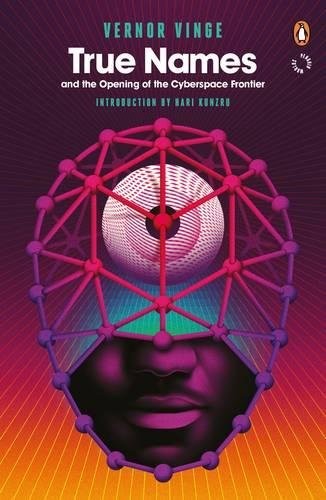
Penguin reissues a seminal work of cyberpunk fiction from the Hugo Award-winning author of A …
"True Names" is Vernor Vinge's fascinating story that is one of the first to present the concept of a cyberspace and is generally considered one of the first stories in what would become the genre of cyberpunk.
In the story, True Names refer to the actual names of persons who have personas in what Vinge calls the "Other Plane". In the Other Plane, those which hacking skills are the 'Warlocks' and they dominate the Other Plane with what is essentially 'magic' since their hacking skills is akin to casting magical spells on regions in that world (which represents hacking computer systems around the world and in space). Of course, the Warlocks would protect their True Names, as once they are known, they can be forced to do the others bidding so as not suffer a True Death (killed).
The story starts with the True Name of Mr Slippery …
"True Names" is Vernor Vinge's fascinating story that is one of the first to present the concept of a cyberspace and is generally considered one of the first stories in what would become the genre of cyberpunk.
In the story, True Names refer to the actual names of persons who have personas in what Vinge calls the "Other Plane". In the Other Plane, those which hacking skills are the 'Warlocks' and they dominate the Other Plane with what is essentially 'magic' since their hacking skills is akin to casting magical spells on regions in that world (which represents hacking computer systems around the world and in space). Of course, the Warlocks would protect their True Names, as once they are known, they can be forced to do the others bidding so as not suffer a True Death (killed).
The story starts with the True Name of Mr Slippery in the Other Plane being discovered by the government. But the government is more concerned with another person known as the Mailman, who has apparently hacked government and possibly military systems without being detected, and they need his help to discover who is the Mailman.
As the story proceeds, Mr Slippery and another hacker discover that the Mailman might not be another human, and may be about to launch a cyber-driven attack on the world. To stop him, they have to grab control of the resources of the US government systems. But even then, the Mailman is a powerful adversary, and they may not be able to stop him while the Mailman is also trying to stop them by sending them to their True Deaths. Worldwide pandemonium in computer systems ensue. In the end, the real identify of the Mailman is discovered, but the world may never be the same.
The story is fascinating for its portrayal of the Other World, where a virtual world is visualized much like a fantasy land. But the landscape is actually a representation of computer systems from around the world: ponds represent data storage, castles represent defended computer systems, and fantasy creatures are the systems that guard the entries to the system. The warlocks themselves are master hackers, able to break into systems, and the battle with the Mailman is the act of controlling and gathering computer resources to dominate and deny them to your opponent.
The book starts with a series of essays on the influence of the story on various people and computer systems at the time. Some essays examine the issue of computer security and the tension between free speech and privacy, and the US government's desire to gather more information on people. Others look at attempts to produce a cyberworld using networked computer systems. The essays, written in the 1990s, are an interesting look at the time when microcomputers and computer networks are just starting to have an influence on society.

Fiction: - "Every Hopeless Thing" by Tia Tashiro - "I Will Meet You When the …
An average issue, with interesting stories by Tia Tashiro and Grant Collier.
"Every Hopeless Thing" by Tia Tashiro: a space scavenger visits a deserted and polluted Earth, only to discover it is not so deserted after all. Her attempts to get them to leave Earth fail, and she realizes that her desire to help every hopeless thing, like her ship that has an AI that was destined for the scrapyard, will be her guide to helping those who prefer to say at home.
"I Will Meet You When the Artifacts End" by Amal Singh: on a colony ship heading to a new world, two people send messages to each over, though they have never met. But plans to do so are interrupted when parts of the colony need to go to deep sleep to save resources. And there is no guarantee they will wake …
An average issue, with interesting stories by Tia Tashiro and Grant Collier.
"Every Hopeless Thing" by Tia Tashiro: a space scavenger visits a deserted and polluted Earth, only to discover it is not so deserted after all. Her attempts to get them to leave Earth fail, and she realizes that her desire to help every hopeless thing, like her ship that has an AI that was destined for the scrapyard, will be her guide to helping those who prefer to say at home.
"I Will Meet You When the Artifacts End" by Amal Singh: on a colony ship heading to a new world, two people send messages to each over, though they have never met. But plans to do so are interrupted when parts of the colony need to go to deep sleep to save resources. And there is no guarantee they will wake up at the same time in the future. But one person is still determined to find the other, or at least, keep some memories of their talks together.
"The Best Version of Yourself" by Grant Collier: the story is set in a future where nanotechnology can allow people to 'edit' themselves to remove unwanted mental states and achieve 'nirvana'. One daughter's mother has undergone the procedure, and she now believes her mother is no longer her mother. But a promise she had made to her mother has to be kept.
"Stellar Evolutions in Pop Idol Artistry" by Em X. Liu: in the future, K-Pop like stars perform to a galactic audience. But like pop stars nowadays, they are made for their roles, and can just as easily be discarded for the next big thing.
"Aktis Aeliou, or The Machine of Margot's Destruction" by Natalia Theodoridou: an explorer crashes on a planet where a strange signal was discovered. The signal turns out to be from a person that, to the explorer (and readers), is basically a god. Now they have to decide how far they want to take their relationship together.
"The Happiness Institute" by AnaMaria Curtis: at an institute that tries to explore happiness, one person decides to dig a pool to be happy, while another discovers a way to mentally connect to others for happiness.
"Born Outside" by Polenth Blake: in a future, some form of children would be born from large seed pods, and adjust to living on a world may not welcome them.

Can be read on-line [ www.beneath-ceaseless-skies.com/stories/boiled-bones-and-black-eggs/ ].
A fun story about a restaurant that caters food for the living and also for the dead. But one day, a dead and very boastful warlord arrives, demands to be fed, and does appear interested in moving on in the afterlife. His demands and insults chase customers away and the restaurant may have to be shut down. But the owner figures out a way to get rid of the warlord, figuratively and literally.

A Brazilian freelance journalist confronts the grim reality her past choices created when she covers …
A story of a reporter who visits a community of people living in a landfill to discover their views on having enough to eat. But what they can now eat may make the reader uncomfortable, and it is the reporter's way of regaining respect, for she once worked at the company that imploded when the method used to allow the landfill people to eat was revealed.
A story of a reporter who visits a community of people living in a landfill to discover their views on having enough to eat. But what they can now eat may make the reader uncomfortable, and it is the reporter's way of regaining respect, for she once worked at the company that imploded when the method used to allow the landfill people to eat was revealed.
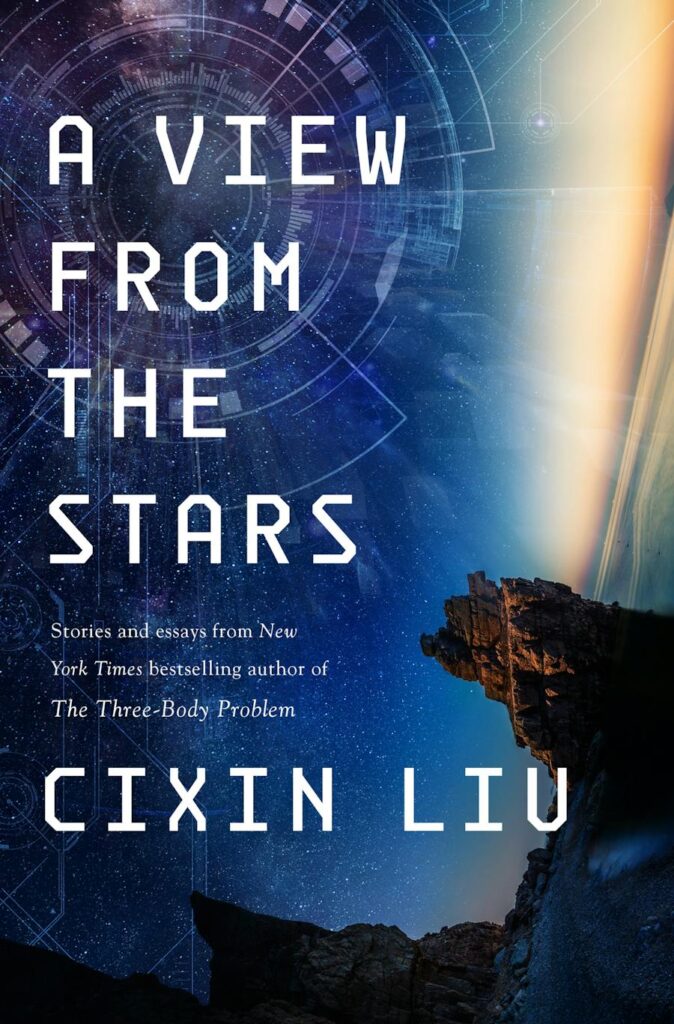
A VIEW FROM THE STARS features a range of short works from the past three …
An interesting collection of translated essays and short stories by Liu Cixin. The essays cover his opinions on SFF in China and his thoughts on the future of technology and humanity. The short stories featured here are mostly hard SF stories that explore the implications of a particular technology on people or on society.