juliana finished reading A Psalm for the Wild-Built by Becky Chambers (Monk and Robot, #1)
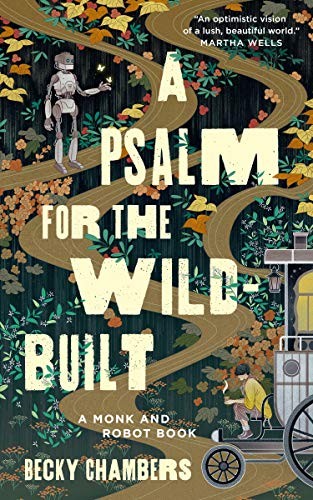
It's been centuries since the robots of Panga gained self-awareness and laid down their tools; …
...oh.
Yeah.
Good.

You know who I am or you wouldn't be here.
This link opens in a pop-up window
It's been centuries since the robots of Panga gained self-awareness and laid down their tools; …
...oh.
Yeah.
Good.
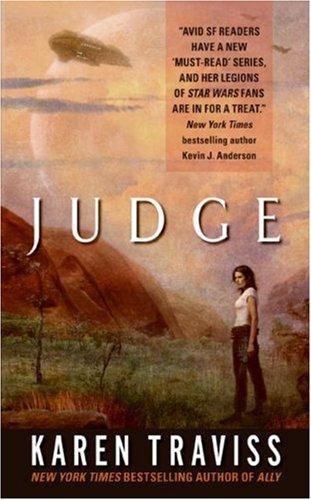
The Eqbas have come, bringing justice, change, hope to some...and death to many.Seeking to punish …
I learned a lot of lessons from this series growing up. One I apparently didn't learn was the final lesson of this book.
Sometimes, it's okay to be selfish.
It's beautiful how timely an otherwise-arbitrary reading choice can become.
I learned a lot of lessons from this series growing up. One I apparently didn't learn was the final lesson of this book.
Sometimes, it's okay to be selfish.
It's beautiful how timely an otherwise-arbitrary reading choice can become.
The worlds orbiting Cavanagh's Star are in turmoil.Civil war on Umeh—ignited by outsiders—threatens to annihilate …
The wildest thing about re-reading these books is not that I'm only realizing how deeply they changed me the first time and how central they have always been to how I conduct myself; it's that they're changing me again.
Anyway, if you want to understand me, read these books. I'm basically a Targassati wess'har isan.
The wildest thing about re-reading these books is not that I'm only realizing how deeply they changed me the first time and how central they have always been to how I conduct myself; it's that they're changing me again.
Anyway, if you want to understand me, read these books. I'm basically a Targassati wess'har isan.
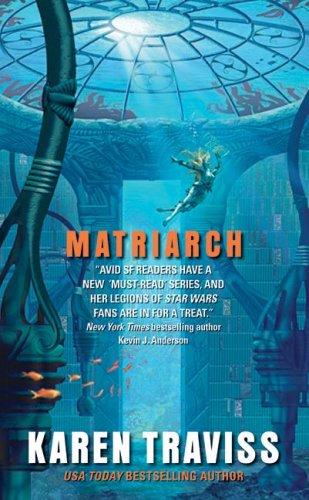
Matriarch is a science fiction novel by the British writer Karen Traviss published in September, …
I've been re-reading this series in large part because I remember being deeply influenced by it as a pre-teen and wanted to see how it held up.
Well, I'd had some realizations to the effect along the way, but this specific books really drove home the extent to which I modeled the kind of woman I wanted and endeavored to be on Shan Frankland.
It's fascinating to see which aspects of myself were shaped by which aspects of her. With my much greater life experience, it's interesting to watch the ways my emotional responses and judgements have evolved, too.
I've been re-reading this series in large part because I remember being deeply influenced by it as a pre-teen and wanted to see how it held up.
Well, I'd had some realizations to the effect along the way, but this specific books really drove home the extent to which I modeled the kind of woman I wanted and endeavored to be on Shan Frankland.
It's fascinating to see which aspects of myself were shaped by which aspects of her. With my much greater life experience, it's interesting to watch the ways my emotional responses and judgements have evolved, too.

Bad takes on ethics, poor demonstration of proper consent. Do not recommend as a guide on those things. The summary of what kink entails could be useful for the uninitiated.

Three separate alien societies have claims on Cavanagh's Star. But the new arrivals -- the …
I read this book (and the entire Wess'har series) back in late middle/early high school, and it had an enormous impact on me. I've never re-read it, so I figured it's time.
I'm about halfway through and it's frankly astonishing how deeply the perspectives of book are reflected in my life, both directly and indirectly.
I'm really curious how I feel about the series's overall theses when I get to them in earnest; I was nowhere near intellectually active the last time I read it.
I read this book (and the entire Wess'har series) back in late middle/early high school, and it had an enormous impact on me. I've never re-read it, so I figured it's time.
I'm about halfway through and it's frankly astonishing how deeply the perspectives of book are reflected in my life, both directly and indirectly.
I'm really curious how I feel about the series's overall theses when I get to them in earnest; I was nowhere near intellectually active the last time I read it.

Read it!

Covering American transgender history from the mid-twentieth century to today, Transgender History takes a chronological …
pretty white and institutional but otherwise it's fine ig
pretty white and institutional but otherwise it's fine ig

Midway through her career, Le Guin embarked on one of her most detailed, impressive literary …
Two words: holy fuck.

AAAA!
It's rare that I read poetry, but yesterday I stumbled across Grolier Book Shop in Cambridge, Massachusetts. I popped in and had a look around, and I picked up and read a bit from this book. It blew me away; I bought it; and this morning I read it cover-to-cover.
Wow.
It manages to capture the ephemeral eternity of love with the knowledge that it will end in a beautiful, consuming, compelling narrative framed as night-time wondering while a lover sleeps.
It's transcendent.
AAAA!
It's rare that I read poetry, but yesterday I stumbled across Grolier Book Shop in Cambridge, Massachusetts. I popped in and had a look around, and I picked up and read a bit from this book. It blew me away; I bought it; and this morning I read it cover-to-cover.
Wow.
It manages to capture the ephemeral eternity of love with the knowledge that it will end in a beautiful, consuming, compelling narrative framed as night-time wondering while a lover sleeps.
It's transcendent.

It's been twenty years and two election cycles since Information, a powerful search engine monopoly, …
I was pretty frustrated by some early sociopolitical commentary in this book, particularly along racial lines, but that lessened immensely after a couple chapters. It's still dripping with imperial core pretention and high academic elitism. Still, the story has some fun beats, the setting - when it stops being imminently self-congratulatory and Liberal - raises some interesting questions, and the analysis of weaknesses in electoral democracy demonstrates a material experience and theoretical familiarity that would be expected of a storyteller with the author's background. The story really picks up about halfway through; until then it's a bit of a slog. All in all, I wouldn't advise buying the book, but if you have access to it and no compelling reads besides, you could do much worse.
I was pretty frustrated by some early sociopolitical commentary in this book, particularly along racial lines, but that lessened immensely after a couple chapters. It's still dripping with imperial core pretention and high academic elitism. Still, the story has some fun beats, the setting - when it stops being imminently self-congratulatory and Liberal - raises some interesting questions, and the analysis of weaknesses in electoral democracy demonstrates a material experience and theoretical familiarity that would be expected of a storyteller with the author's background. The story really picks up about halfway through; until then it's a bit of a slog. All in all, I wouldn't advise buying the book, but if you have access to it and no compelling reads besides, you could do much worse.
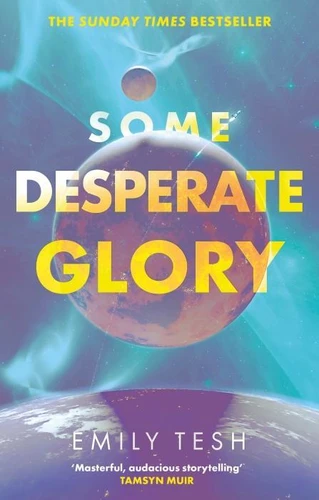
All her life Kyr has trained for the day she can avenge the murder of …
From time to time, humanity is gifted the formation of a writer of such unimaginable capability and spirit that their work may reorient our past and reshape our future. Science fiction has had no shortage of such writers: Verne, Asimov, Le Guin, to name only a few — and now Tesh.
While this is her debut novel, it is obvious that Emily Tesh has refined her craft for much longer than the writing of one novel. This book is a finely-wrought masterwork with the precision and efficiency of Traviss, the soul and insight of Le Guin, and a creativity and compassion all her own. I cannot wait to delve into her prior work and to see what she creates next.
Heed the content warning at the beginning of this book, though it's not as bad as it could be. But if you have any interest in antifascist military …
From time to time, humanity is gifted the formation of a writer of such unimaginable capability and spirit that their work may reorient our past and reshape our future. Science fiction has had no shortage of such writers: Verne, Asimov, Le Guin, to name only a few — and now Tesh.
While this is her debut novel, it is obvious that Emily Tesh has refined her craft for much longer than the writing of one novel. This book is a finely-wrought masterwork with the precision and efficiency of Traviss, the soul and insight of Le Guin, and a creativity and compassion all her own. I cannot wait to delve into her prior work and to see what she creates next.
Heed the content warning at the beginning of this book, though it's not as bad as it could be. But if you have any interest in antifascist military sci-fi, in what it means to fight injustice in a hopeless world, or just a good damn book, give it a read.
And if, by some twist of fate, Emily Tesh ever reads this review: thank you. I didn't even realize there was still a Gaea inside me, and now I know what to do about it.

Investigator Mossa and Scholar Pleiti reunite to solve a brand-new mystery in the follow-up to …
i love oblivious lesbians

The Mimicking of Known Successes presents a cozy Holmesian murder mystery and sapphic romance, set …
thank you autistic butches; thank you autistic fems; thank you sapphics of all kinds