Overly Simplistic
1 star
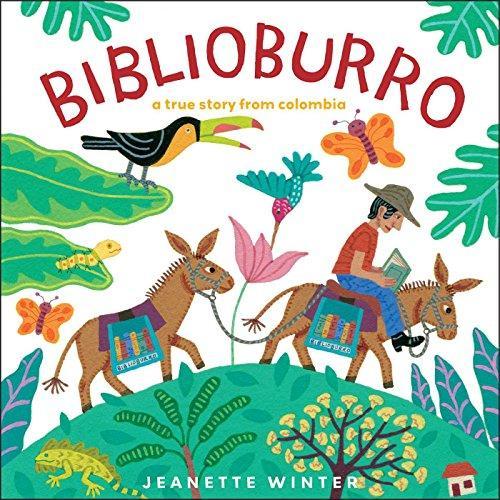
Based on real events, this book focuses on telling a story about one of Luis Soriano's travels to a remote village with his burros. This book was described to me by many teachers as a "good resource to learn about Colombia," but I find that I disagree.
Luis's story is interesting, and I do think that it deserves to be told. However, I feel like this book structures his work in a way that makes it palatable and includes elements without considering the implications of how it's being done.
Part of what makes me feel this way is that there is a brief scene where a bandit tries to hold up Luis (demanding his silver) and then steals a book instead, letting him go. While I'm not going to discount the possibility of its veracity, I do find that its inclusion would still lead children to the …
Based on real events, this book focuses on telling a story about one of Luis Soriano's travels to a remote village with his burros. This book was described to me by many teachers as a "good resource to learn about Colombia," but I find that I disagree.
Luis's story is interesting, and I do think that it deserves to be told. However, I feel like this book structures his work in a way that makes it palatable and includes elements without considering the implications of how it's being done.
Part of what makes me feel this way is that there is a brief scene where a bandit tries to hold up Luis (demanding his silver) and then steals a book instead, letting him go. While I'm not going to discount the possibility of its veracity, I do find that its inclusion would still lead children to the stereotype that everyone making journeys to rural Colombia is constantly held up at the whims of bandits. It feels like the common media depiction of everyday life, when I'm sure the kinds of negative impacts that people endure on the daily basis are of a wider variety.
I also think it undermines the story that Luis, himself, explained; he had seen that the students he worked with, as a schoolteacher (a thing that is conveniently left out of the main text and is only mentioned in a quick biographical note at the back that can be easily skipped over), endured a wide variety of hardships and wanted to do what he was able in order to provide more for many children. Though the writer does have him say, multiple times, that "the children are waiting," it doesn't have those implications (which I think, also, would've been far more engaging to children than a random hold-up by a bandit).
It's also unclear what Luis is doing, especially if you do read the biographical note. The main text makes it seem like Luis is just giving away his books, when the reality is that he developed a kind of library system that focuses primarily on people with limited or no access to books. The library building that is part of this project is located right next to his house and contains thousands of books, many of which were donated to him from people all over. This library's construction was finished in 2009, and I point this out because the book was published in 2011; this is something that could've easily been included and made a more coherent "true story."
I also get this kind of frustrating moral lesson from the book that a lot of older people do to children, and it's reminiscent of the ways in which my parents would always harass me about finishing all of the food on my plate because "there are children starving in Africa." Rather than really focusing on Luis's life and his work toward building the Biblioburro, it practically does the "some children have no books to read, so you should feel lucky that you have them" lesson. I'm not overly comfortable with that for a range of reasons, and I can't help feeling like that's something that kids will walk away with either as an indirect lesson or a direct lesson (especially if this is taught within the realm of a classroom, as I can almost certainly recognise precisely where teachers would point this out to their "ungrateful" students).